
How to Use Academic Essay Structures to Win Business Proposals.

Crafting a compelling business proposal can feel like an art form, a delicate balance of persuasion, data, and vision. But what if the secret to elevating your proposals lay not in groundbreaking new techniques, but in a familiar framework from your academic past? Believe it or not, the disciplined structure of an academic essay holds immense power to transform your business proposals from mere documents into persuasive, winning arguments.
Forget the dry, formulaic essays you might remember from school. The core principles behind a well-structured academic argument—clear thesis, logical flow, evidence-based reasoning, and a compelling conclusion—are precisely what successful business proposals demand. In a competitive market, a proposal that’s not only innovative but also meticulously organized and easy to digest stands a far greater chance of securing that crucial “yes.”
Think about it: whether you’re a student striving for an A-grade or a business professional vying for a multi-million dollar contract, you’re both engaged in the act of persuasion. You need to present your case, support it with credible evidence, address potential counterarguments, and ultimately convince your audience of the value and validity of your proposition. If you ever found yourself struggling with essay writing, remember that expert essay writer service resources are available to guide you through the process, and many of those same principles apply directly to crafting impactful proposals.
The Foundation: Thesis, Introduction, and the All-Important Hook
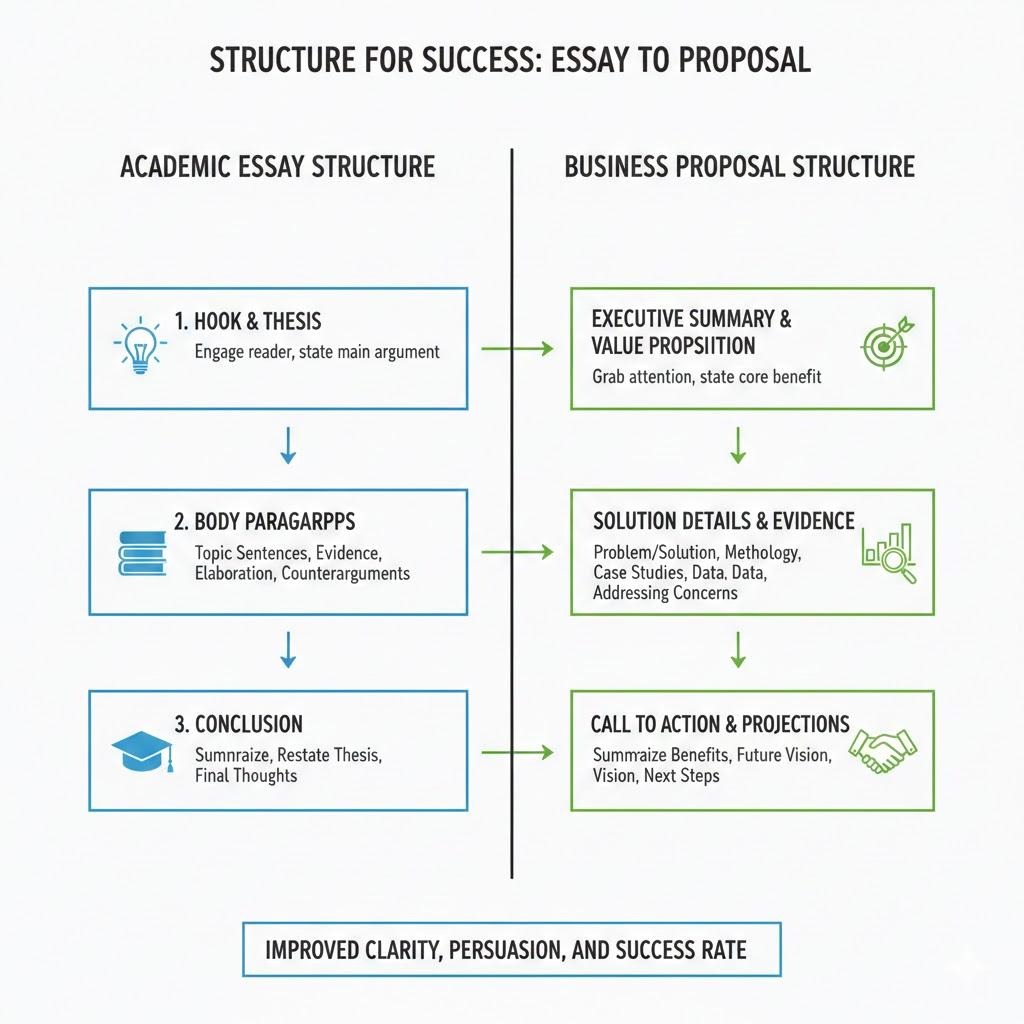
Every strong academic essay begins with a clear thesis statement—a concise declaration of the essay’s main argument. In the business world, this translates directly to your proposal’s core value proposition. What is the single most important message you want your reader to take away? What problem are you solving, and what unique benefit are you offering? This should be articulated upfront, preferably in your executive summary and the initial paragraphs of your proposal.
Following the thesis, a compelling introduction is crucial. Just as a captivating essay hook grabs the reader’s attention and sets the stage for the argument, your proposal’s introduction needs to immediately engage the client. Start with a clear understanding of their pain points, demonstrate empathy for their challenges, and then subtly introduce how your solution will address these issues. This immediate relevance creates buy-in and encourages the reader to delve deeper.
A study by the Association of Proposal Management Professionals (APMP) revealed that proposals with clear and concise executive summaries are 30% more likely to be read in their entirety. This underscores the importance of a strong “thesis” and “introduction” in capturing initial attention.
Building the Body: Evidence, Elaboration, and Logical Flow
Academic essays develop their arguments through body paragraphs, each focusing on a specific point supported by evidence. In business proposals, this translates to dedicated sections that elaborate on different aspects of your solution, methodology, team expertise, and projected outcomes.
- Evidence-Based Reasoning: Just as academic essays rely on research, data, and expert opinions, business proposals thrive on concrete evidence. Don’t just claim your solution is effective; prove it. Include case studies, testimonials, market research data, financial projections, and clear metrics. For instance, instead of saying “Our software improves efficiency,” state “Our software, implemented at XYZ Corp, led to a 25% reduction in operational costs within six months, as detailed in our attached case study.”
- Logical Progression: Each section of your proposal should flow logically from the last, guiding the reader through your argument seamlessly. Think about the “signposting” used in essays—clear topic sentences and transition words. Similarly, use headings, subheadings, and introductory sentences for each section to provide a roadmap for your reader. This prevents your proposal from feeling disjointed and ensures your message is absorbed effectively. According to a Forbes article, poorly structured proposals are a leading cause of rejection, regardless of the quality of the solution itself.
- Addressing Counterarguments (Anticipation and Rebuttal): A sophisticated academic argument often acknowledges and refutes potential counterarguments. In business proposals, this means proactively addressing potential client concerns, risks, or objections. Demonstrate that you’ve considered all angles and have strategies in place to mitigate any challenges. This builds trust and demonstrates a thorough understanding of their needs and potential anxieties.
To illustrate this structure, consider the following infographic depicting the parallel elements:
`
The Concluding Punch: Reinforcing Value and Call to Action
Just as a strong essay concludes by summarizing key points and restating the thesis in a fresh way, your business proposal needs a powerful conclusion. This is not merely a summary; it’s an opportunity to reiterate your core value proposition, reinforce the benefits, and inspire confidence.
- Reiterate Benefits: Briefly remind the client of the primary advantages your solution offers, linking back to their initial pain points. Quantify these benefits wherever possible (e.g., “Our solution will not only streamline your operations but is projected to deliver a 15% ROI within the first year”).
- Future Vision and Call to Action: Look beyond the immediate solution. Paint a picture of the positive future the client can achieve by partnering with you. Finally, and most importantly, include a clear and concise call to action. What do you want them to do next? Schedule a meeting? Sign a contract? Initiate a pilot program? Make it effortless for them to take the next step.
A study by Accenture found that proposals with a clear, direct call to action have a 20% higher conversion rate compared to those that leave the next steps ambiguous.
EEAT: Establishing Trust and Authority
In today’s digital age, the principles of Expertise, Experience, Authoritativeness, and Trustworthiness (EEAT) are paramount, not just for search engine ranking but for building credibility with your clients.
- Expertise & Experience: Highlight your team’s qualifications, relevant experience, and industry knowledge. Include brief bios of key personnel involved in the project.
- Authoritativeness: Reference industry standards, certifications, and any awards or recognitions your company has received. Use data from reputable sources (e.g., market research firms, academic journals) to back up your claims.
- Trustworthiness: Be transparent about your methodology, pricing, and potential challenges. Provide client testimonials and case studies. A consistent track record of success is your most powerful trust-building tool.
By consciously incorporating these academic essay structures into your business proposals, you’re not just creating a document; you’re constructing a persuasive argument designed for success. You’re demonstrating clarity, foresight, and a profound understanding of both your solution and your client’s needs. So, the next time you sit down to draft a proposal, remember the power of the academic essay—it might just be the secret weapon you’ve been overlooking.
Key Takeaways
To ensure your business proposal doesn’t just inform but actively persuades, keep these strategic parallels in mind:
- The “Thesis” is Your North Star: Never bury the lead. Your value proposition should be as clear as an academic thesis statement, appearing early in your executive summary to define exactly how you solve the client’s problem.
- Hooks Drive Engagement: Use the principles of a strong essay hook to open your proposal. By starting with a surprising industry statistic or a direct acknowledgment of the client’s specific “pain point,” you ensure they read past the first page.
- Evidence-Based Credibility: Just as a professor looks for citations, a decision-maker looks for proof. Replace vague promises with “Data Points” (e.g., “30% increase in efficiency” vs. “better results”).
- Logical “Signposting”: Use clear headings and transitions to guide the reader. A proposal that follows a logical sequence—Problem, Solution, Methodology, Budget—is significantly easier to approve than a fragmented one.
- Anticipate the “So What?”: Academic writing requires you to address counterarguments. In proposals, this means proactively answering “What if this fails?” or “Why is this better than the cheaper competitor?” to build trust.
- Structure Equals Professionalism: Utilizing professional essay help techniques ensures your document remains objective, authoritative, and free of the “fluff” that often kills corporate deals.
FAQ
Q1: Is this approach suitable for all types of business proposals?
A: Yes, while the level of detail may vary, the core principles of clear structure, logical argument, and evidence-based persuasion are universally applicable to proposals ranging from small project bids to large corporate contracts.
Q2: How can I ensure my proposal isn’t too “academic” and remains engaging?
A: The goal isn’t to make it sound like a research paper. It’s about adopting the structure for clarity and persuasion. Use clear, concise business language, incorporate visuals, and maintain a client-centric tone focused on benefits and solutions.
Q3: What’s the most common mistake businesses make when structuring proposals?
A: A frequent error is a lack of clear focus and disorganized information. Proposals often jump between topics without clear transitions, making them difficult to follow and understand. Another common mistake is failing to adequately support claims with credible evidence.
Q4: How do I incorporate EEAT principles without sounding boastful?
A: Focus on facts and results. Instead of saying “We are the best,” state “Our team holds X certifications and has successfully delivered Y project, resulting in Z outcome.” Use testimonials and third-party data to validate your claims.
Q5: Should I include an abstract like an academic paper?
A: In business proposals, the executive summary serves a similar purpose to an abstract. It provides a concise overview of the entire proposal, highlighting the problem, solution, benefits, and call to action. It’s often the most critical section for initial review.
Author Bio:
Sarah Jenkins is a Senior Content Writer at MyAssignmentHelp. With a background in business communications and a passion for clear, impactful writing, Sarah specializes in helping students and professionals alike master the art of persuasive communication. Her insights draw upon years of experience in crafting compelling narratives, whether for academic success or strategic business growth.
